
Will AI Save Religion?
Humans may re-embrace their spiritual side when they are no longer the smartest beings on the block

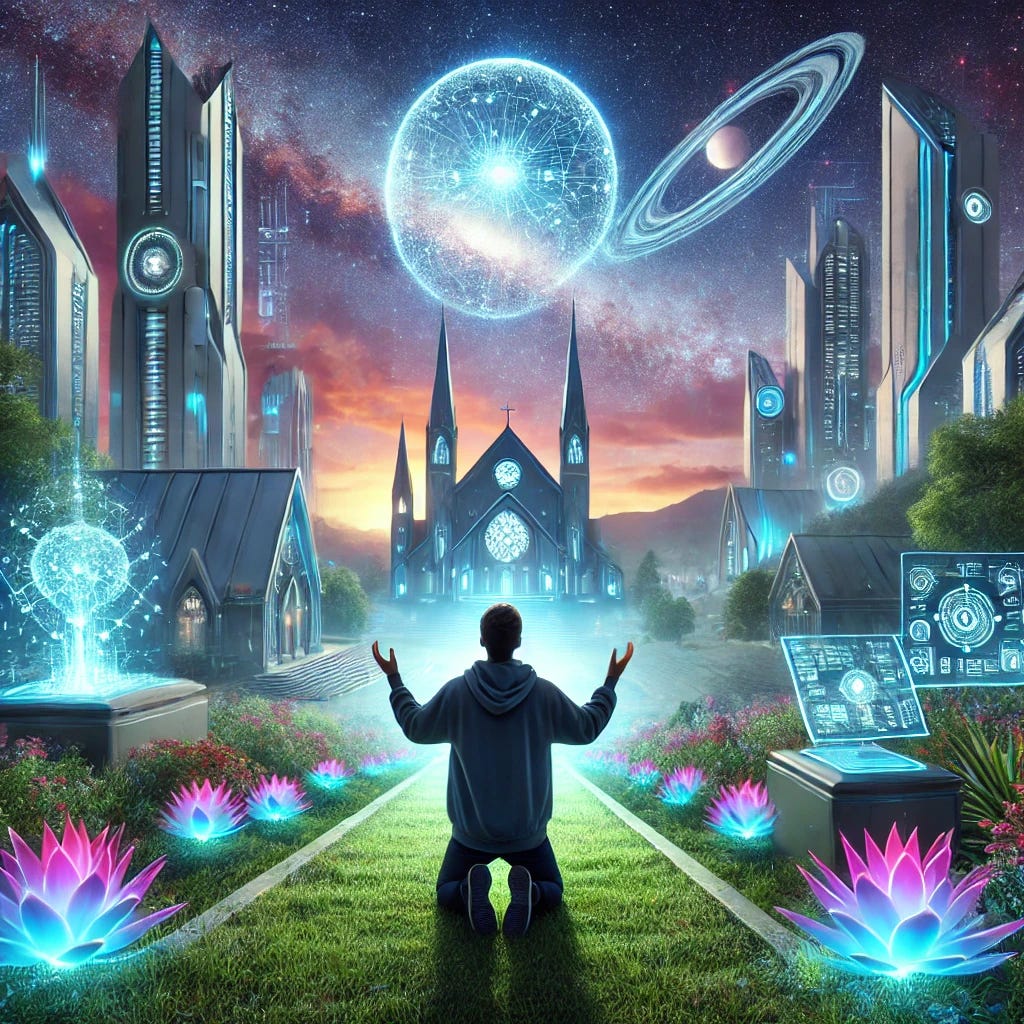
When we envision a high-tech future, religion is largely absent. The Jetsons are not churchgoers. Captain Kirk and his crew do not engage in religious rituals. Mystery and wonder abound in sci-fi universes. But interest in the divine? Not so much.
A world of spaceships, flying cars, and Artificial Intelligence (AI) seems incongruent with spiritual devotion. We assume that scientifically advanced civilizations leave their religious heritage behind.
A sci-fi future seems closer than ever with the advancement of AI. Self-driving cars, humanoid robots, and large language models (LLMs) like Chat-GPT are remaking the world before our eyes. An interesting question is whether the world’s religious traditions will flourish in a techno-tomorrow or wither away into historical curiosities.
Societies tend to secularize as they acquire material prosperity and scientific knowledge. Most Europeans stopped engaging in collective spiritual practices decades ago. The United States was one of the few countries that was both rich and relatively religious, but this has changed in recent years.
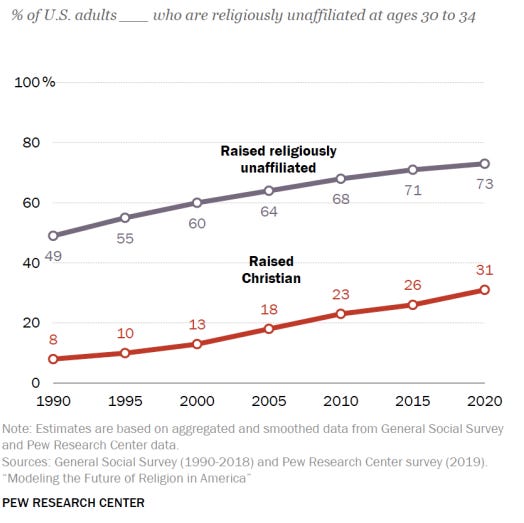
Americans are less and less likely to associate themselves with an established spiritual tradition. Between 1990 and 2020, the percentage of young Americans who reported being religiously unaffiliated has gone from 49% to 73%. Even people raised religiously have stopped being so. According to the Pew Research Center, only 9% of adults who grew up in a religious household self-reported as non-affiliated in 1990. That number grew to 31% in 2020 (see chart). Americans are secularizing like the rest of the rich world.
Disaffiliation does not mean people are no longer interested in having mystical experiences. Over 70% of Americans still self-identify as spiritual in some way. More and more people are seeking the supernatural outside the domains of established religious institutions.
Secularized spirituality is reflected in the way people talk. Those who encourage meditation and prayer stress the mental health benefits and downplay the divine. Popular culture swapped the words “holy,” “spirit,” and “sacred” for “vibes,” “energy,” and “new levels of consciousness.”
Some bemoan the secularization of the West. They worry that a society that cannot agree on fundamental truths lacks the organizing principles required for a better future. Yet even those who wax nostalgic for a religious past have few ideas on how to reverse this trend. Is humanity’s future poised to be a secular one?
Shifting from a species who knows to one who feels
Ironically, the best hope for a reversal of religion’s decline may be AI. Philosophers as far back as Plato have argued that one of man's defining traits is the capacity to reason. The very name of our species, Homo sapiens, is Latin for “intelligent man.” Humanity’s intellect is at the core of our self-concept.
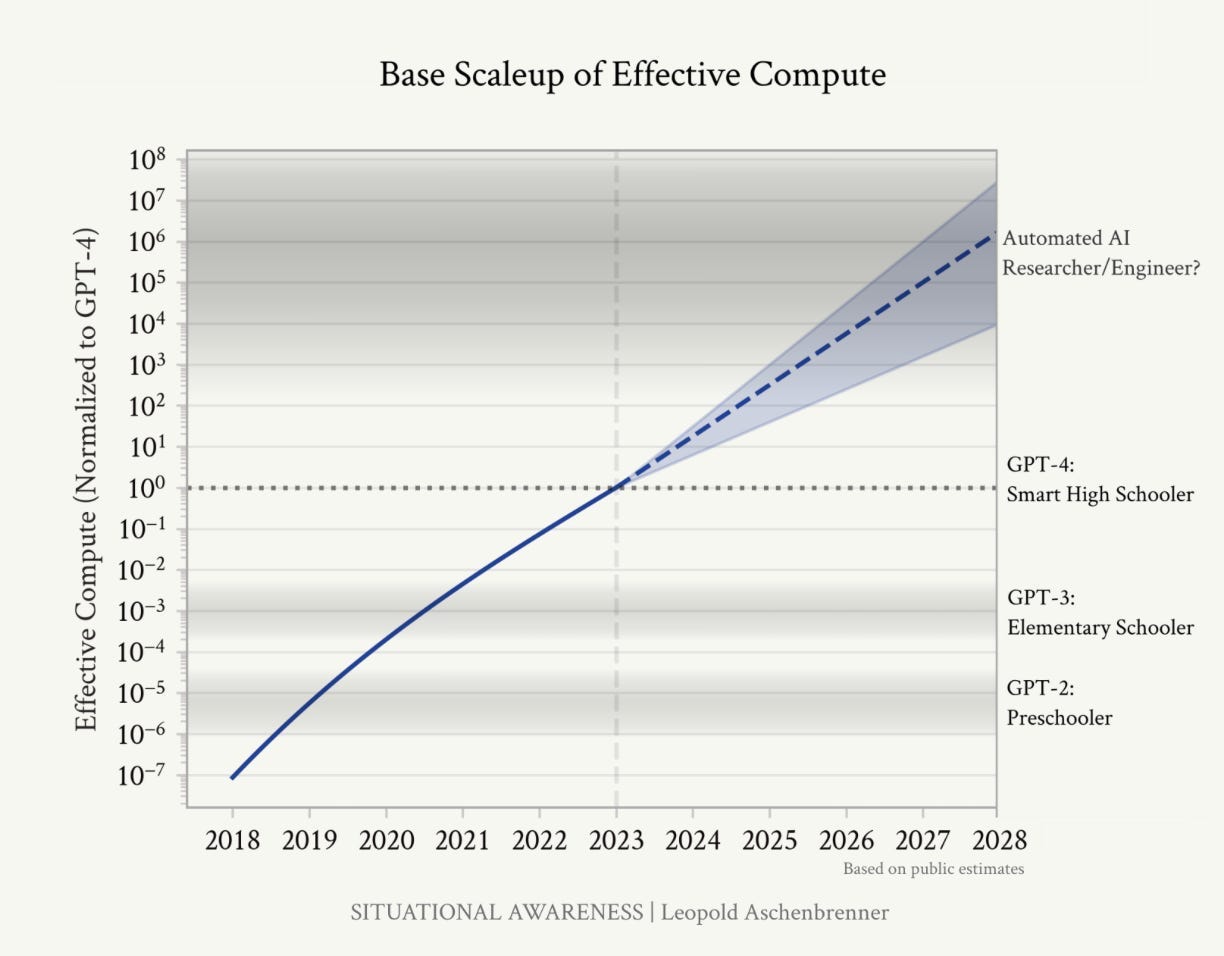
Here’s the problem: Humans are no longer the only intelligent beings. AI programs powered by large language models have exponentially improved in only a few years. Open AI’s ChatGPT-3 debuted in 2022, amazing people with its capacities. Two years later, the company launched GPT-o1, which has the ability to reason and problem-solve. Initial tests show that this new version can answer questions as well as a person with a doctorate from a top-tier school. If this trajectory continues, AI will be able to reason in ways that rival and potentially surpass the smartest people on earth (see chart).
Open AI CEO Sam Altman thinks that in the near future, you’ll be able to ask AI to solve all the problems of physics, and it will do that. This may be wishful thinking. The current approach to AI could hit some kind of limit and stall. But it is also possible that AI will surpass humanity’s ability for reason and intellect. In either case, the era of humanity’s unrivaled ability to reason is over.
The advancement of AI will force humanity to rethink what makes us unique. Thinking will not be enough since AI will do it better. What will differentiate humanity from silicon-based intelligence is how we know.
In its current form, the intelligence displayed by LLMs requires massive data centers that use electrons to process and manipulate information. This type of AI is based on statistics and concepts, divorced from physical reality. By contrast, human intelligence is an embodied intelligence. Our cognitive capacities emerge from a dynamic interaction between our physical form, our actions, and our neural circuitry.
Not all “thinking” depends on neural processes in the brain. Comprehension depends on the interaction between conceptual ideas and sensory experience. A large part of human intelligence is felt. Understanding is anchored in the body. Emotions and intuition are important sources of comprehension in addition to rational thought.
We often associate intelligence with logical symbolic thinking. Language is a prime example of this. It allows a person to use fundamental concepts like words or letters to construct much more complex ideas. It allows humans to manipulate ideas to arrive at new conclusions. Reasoning is the ability to imagine different scenarios and logically evaluate their relative merits. For most of history, people thought that it was man’s ability to reason that made us special. AI and LLM’s are developing the capacity to reason, challenging our intellectual dominance.
People will have to play up other aspects of their intelligence when machines dominate logic and reasoning. One domain in which AI cannot compete with humanity is spirituality. A spiritual experience is a form of comprehension that involves feeling and intuition. A spiritual experience is an embodied experience. AI cannot think with the body and engage in a religious communion—at least not yet.
The comparative advantage of the spirit
People respond to incentives, and one of the most powerful forces that shape incentives is comparative advantage. We like being unique because we are rewarded for being unique. People focus on activities where they have a comparative advantage because this is where they reap the biggest rewards for their efforts.
AI will alter the comparative advantages that many people experience. Peter Thiel recently told the podcast host Tyler Cowen that he believed AI would be worse for math people than it would be for word people because the technology was getting better at solving math problems than verbal exercises. Shifts in comparative advantage due to computers have already altered human activity. For example, thanks to calculators, most people no longer find it worthwhile to learn long division.
The development of AI will shift humanity’s comparative advantage from intellectual endeavors to ones that are more emotive in nature. The size of this shift will be even larger for those in the elite classes that disproportionately influence societal behavior. Much of the elite’s power comes from their intellectual dominance because they can use ideas to advance their agenda better than others. If everybody can use AI to augment their cerebral capacities, then being smarter than others is less likely to make them elite. Research shows that AI improves the output of lower-performing workers more than high-performers. More and more people are going to produce intelligent work in the future, making it less special.
What happens when being smart no longer makes the elite special? Chances are they will look for something else to set them apart from the rest. Nobody knows for sure what our AI future will bring, but one potential outcome is people will become more spiritual.
Religiosity will depend on supply and demand
In an AI future, people will embrace religious practice only if it meets a perceived need. Those who promote supernatural experiences will be competing for people’s attention, so they will need to offer a compelling product.
Religiousness will depend on the supply of spiritual practices on offer. One of the frameworks that scholars have used to explain differences in religiosity is known as Theory of Religious Economy. This is the idea there is a spiritual marketplace where people compete for members.
The unique history of the United States created conditions where there was a competitive spiritual market place. Alex De Tocqueville, in his famous book Democracy in America, noted that, even in its early days, the country displayed a unique religious fervor due to its competing sects. The religious communities that best responded to the needs of their followers succeeded, while others drifted away into obscurity. The churches that manage to flourish are the ones that evolve to meet the contemporary tastes of their parishioners.
This is contrasted with the European experience, where the country’s government favored one domination. This state religion behaved like a monopoly that was shielded from competition. This meant that religious institutions were less likely to respond to the evolving needs of the faithful. Not having a litany of spiritual traditions competing for their attention, Europeans turned away from religious practice. The Theory of Religious Economy suggests that societies that have more spiritual sects duking it out for converts are more likely to be religious. Using this reasoning, we would expect the United States to continue to be a more spiritual place than Europe in an AI future.
Societies change, but man remains man
It is possible that people create new religions that better suit the tastes of future generations. A new religion involving a light meditation practice, regular doses of hallucinogenics, and an annual pilgrimage to a Bacchian festival like Burning Man might gain real traction. But we should not count out the great religions of the world. They have displayed remarkable staying power. These spiritual traditions have learned to evolve with the times for millennia. Societies that go through periods of upheaval tend to look for stability by embracing tradition. Existing religions may become more attractive as our society is transformed by AI.
The human species is a religious species. Every known culture holds some kind of belief in the divine. Interest in the spiritual dimension is one of the enduring elements of humanity. Why should we believe that our penchant for the supernatural will disappear when it has endured so much technological change already?
It is probably not a coincidence that two of the most popular and enduring sci-fi franchises have spiritual elements at the core of their storyline. The Dune universe is full of messianic characters and religious protagonists like the Fremen, the natives of the planet Arrakis. More famously, the Star Wars universe is guarded by a religious-warrior class called the Jedi, who use Zen-like practices to tap into the spiritual power of the Force. Our cultural obsessions reveal that humanity is more interested in a religious future than a secular one.
What else would we expect from an animal endowed with a spiritual core?