
Island Economics
Where the sand is soft and the economics are hard

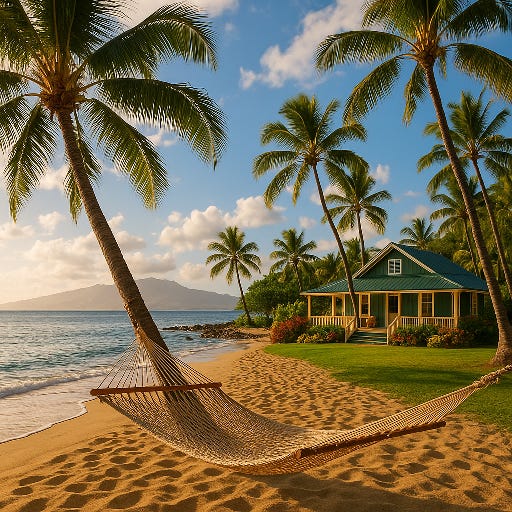
My favorite Hawaiian music song is On the Islands by John Cruz. The rhythms wax nostalgic and slow. There is talk of family and food. The song is—like island life—repetitive, but that’s part of its charm. On the islands, we do it island style, goes the chorus. Tropical destinations move to their own beat. The art of island living is learning to match it.
The idyllic lifestyle comes with costs. It is hard to make a living on an island, and everything tends to be more expensive. Living off fresh fish and coconuts sounds great, but living out your personal version of Treasure Island quickly collides with another set of basic wants, like educating your kids, affording a decent home, and putting food on the table. The same things that make islands attractive also make them hard places to live. The opportunities and challenges of an island’s economy are downstream of its geography.
Characteristics of island economies
Economic isolation: Let’s start with the first thing most people think of when they dream of moving to Margaritaville: isolation. An island is a place where you can get away from it all. The geography makes it hard to interact with other people. Living off the grid sounds romantic, but it makes engaging in commerce quite difficult.
Islands are disconnected from large cities that produce the bulk of economic output. A key source of innovation and wealth derives from agglomeration effects. This is a fancy economic term that describes the efficiency gains that occur when lots of people come together. Even in the age of remote work and Zoom calls, something special happens when people are together in the same room. Large cities are the engines that fuel our economy. Over half of U.S. GDP is generated in just 23 urban districts.
The traditional solution to the problem of geographic disparities is infrastructure. The government builds railways, canals, and highways that connect smaller towns to the metropolises, which gives more people an opportunity to participate in urban markets. Islands cannot do this. They have to rely on ocean shipping lanes for commerce and aircraft for travel. This dramatically increases the costs of island living.
Economies of scale: Small may be beautiful in many cases, but this is generally not true in economics. Economies of scale, which lower the unit cost of production, are a key source of productivity gains. The modern economy is able to produce millions of different products at relatively low prices because it has large, specialized factories.
A phrase that you habitually hear living in Hawaii is “it’s a small island, ”meaning that everybody is one or two degrees of separation from one another. Because you often run into the same people again and again, you have to be more cautious in your interactions because bad behavior will come back to haunt you sooner than you think. Smallness breeds intimate community, but it discourages economies of scale.
Achieving adequate economies of scale is difficult on an island. It is even worse on an island chain like Hawaii. There are seven islands, each with its own semi-independent economy. A construction worker or builder on Oahu can’t drive over to Maui for a day of work. Specialization and achieving economies of scale become even more challenging, which in turn inhibits economic growth.
Island Oligopoly: Because the market is small, there are only a few businesses providing a service, which limits competition. In Hawaii, there are only three major banks operating in the state. They are keenly aware of each other’s behavior and refrain from aggressively competing, fearing that they would cannibalize each other's profitability. Economists refer to this type of market as an oligopoly.
The number of market participants affects the behavior of a market. In a monopoly, there is only one business providing the product. A monopolist can limit production to raise the price, thereby increasing its profitability. In most places, governments either make monopolies illegal or heavily regulate them because of their tendency to create unfavorable outcomes for consumers.
In a perfectly competitive market, there are many producers. The competition is fierce in this market, which drives down prices. This is generally beneficial for consumers, but detrimental to producers. Between these two types of market conditions lies oligopoly, where there are only a few firms producing the good or service. The firms want to avoid an all-out price war that would harm their profitability. This means that prices are higher than they would be in highly competitive markets, which hurts consumers.
Many island markets behave like oligopolies. A small number of companies tend to play nice with their competition and maintain the status quo. This limits the opportunity for growth, but it ensures profit stability. The lack of competition in island economies leads to higher prices overall.
Specialization: Small open markets tend to specialize in one or two industries. They lack the population and resources to generate economies of scale in many industries. In the case of Hawaii, it specializes in tourism and the military.
Most island economies specialize in tourism because it is an exportable service (people from outside the islands trade their money for the privilege of visiting the islands). Tropical islands have such a strong comparative advantage in tourism that it is hard for them to develop other industries. This is not a bad thing. High tourism prices make islands richer than they would otherwise be if they specialized in something else. A Hawaii that specializes in tourism is richer than one that specializes in pineapple production.
Vulnerable Economies: Since island economies are not well diversified, they are vulnerable to external shocks. When COVID-19 stopped all travel for nearly a year, countries whose economies rely mostly on tourism dollars declined the most. Natural disasters and other one-time shocks can have larger and longer-lasting effects on islands.
The country most affected by hurricanes is the United States. Year in and year out, you hear on the news of massive storms hitting the Southeastern coast, costing billions of dollars in damage. These unfortunate events never cause a national recession. America is so large and diverse that such tragedies do not have a significant impact on its economic output.
This is not true for islands. Their economies are so small and heavily reliant on tourism that a single hurricane can cause a drastic reduction in GDP. Nine of the top ten countries with the worst economic loss from a single disaster event between 2000 and 2019 were small countries in the Caribbean. The other country was the island nation of Samoa.
Climate change poses a particular challenge to islands. Usable land is already scarce in these places. Sea level rise devours the little land that exists. Island economies were already susceptible to external shocks. Climate change turbocharges this problem by increasing the frequency of extreme weather events.
Fewer markets; more community: Markets are mechanisms that help human beings collaborate efficiently. International supply chains enable people from all over the world to produce products like pencils at incredibly low cost. Market mechanisms are most effective at scale when many people participate. Most islands do not offer the scale needed for efficient markets.
The formal oversight systems that prevent conflicts of interest and corruption in large economies—like independent boards and regulatory agencies—are difficult to implement on islands where everyone knows each other. Most professionals in a given industry have worked together at some point and intermingled their interests.
Governance mechanisms and institutional arrangements that investors expect when making investments are challenging on a small island where everybody knows each other. Islanders must think of innovative ways to organize themselves that ensure good behavior while acknowledging the realities.
Outmigration: Most island economies are poorer than other jurisdictions on the mainland. This creates another problem: outmigration. Local inhabitants, especially those who are young and capable, tend to migrate to places with greater economic opportunities. Hawaii has one of the highest ratios of people over 65 relative to the working age population (18-65) of any state in the country. This creates a self-fulfilling dynamic where the lack of business opportunities causes people to leave, which in turn degrades the quality of the labor force, making it even harder for businesses to grow and prosper.
If the economics are so bad, what is an island to do? They double down on what makes them unique. In some cases, this is an attractive environment. Tropical breezes, crystal-clear turquoise waters, and lush green foliage attract tourists from around the world. Other islands exploit their strategic location. Singapore serves as the trading hub for all of South East Asia because it sits at the mouth of the Malacca Straight, the busiest shipping lane in the world. Hawaii is richer than most islands because it is home to the only deep-water port in the North Pacific, making it an important military asset.
Hard economics make for hard politics
The same factors that make island living special also make it economically challenging. I thank my lucky stars every time I jump into the Pacific Ocean in December wearing nothing but board shorts, thousands of miles away from cold weather, exhausting politics, and the rat race. Yet, the remoteness that makes it easier to slow down also increases my food costs and limits my professional opportunities. Living in a community permeated with the spirit of Aloha, where I run into my colleagues at the grocery store, is wonderful. But a small community means that there are only a few industries driving the economy, and the talent pool is extremely limited.
People’s love of island life predisposes them to be wary of change. The slow tropical vibes that attracted people in the first place seem antithetical to economic development. While completely understandable, the anti-growth vibe creates a litany of problems.
Change is the only constant in the universe, and that includes islands. Societies and economies evolve whether people want them to or not. When islanders restrict new construction and chase out emerging industries that destabilize the status quo, they inadvertently make housing more expensive and limit the source of good-paying jobs.
This makes it harder for their children to build a life for themselves nearby. They move off the island in search of the middle-class life they were taught to expect. The outmigration leads to a loss of culture and a way of life that the anti-growthers were trying to preserve in the first place.
The Internet has allowed islands to more easily integrate with the global economy. But in an ironic twist, integration has exacerbated preexisting problems. Remote workers move to island economies to take advantage of the good life. This puts upward pressure on already high real estate prices. Because the politics of islands tend to be anti-construction, higher prices do not lead to increased supply. As a result, economic integration makes shelter even less affordable for much of the the local population.
The economics and politics of islands have certain challenges, but they also come with built-in advantages. It is much easier to develop and execute a collective vision in small societies. On an island, it is possible to gather the leaders of all the major constituency groups in a single room, where they can debate the kind of future they want, decide on it, and make it a reality. Building a coherent community that breeds trust is easier in a place where everyone is your neighbor.
Syncing with the vibes of the surroundings is essential to a successful life on the islands. It is also important to acknowledge the economic constraints facing the place as you develop a unified vision for a shared future.
Central America has many of the same issues with Island Economics. There is isolation economically because of politics (island effect of politics) in small countries. Little mobility of labor between small countries, oligopolies in business, and isolation with borders.
Living island-style is more than a mood, it’s a delicate balance between charm and challenge, tradition and transformation.